Every SNLS stitch is a small piece of precise timing. When an operator or mechanic understands how the stitch forms, most stitching faults become easy to explain - and to fix.
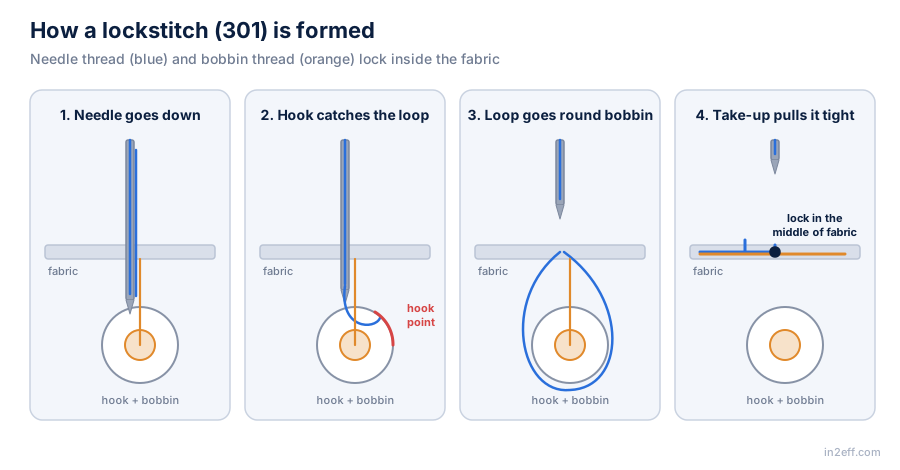
The parts that make the stitch
| Part | Job |
|---|---|
| Needle | Carries the upper thread through the fabric |
| Rotary hook | Catches the needle-thread loop and carries it round the bobbin case |
| Bobbin & bobbin case | Holds the lower thread; the case spring sets bobbin tension |
| Take-up lever | Pulls the needle thread up and sets the stitch tight |
| Feed dog + presser foot | Move the fabric one stitch length forward |
| Tension discs | Control how much upper thread is released |
The four steps
- Needle goes down through the fabric, carrying the upper thread.
- Needle starts to rise (about 2 mm). The thread on the scarf side forms a small loop, and the hook point catches it.
- The hook carries the loop round the bobbin case. The bobbin thread is now inside the loop.
- The take-up lever pulls the thread up, the loop closes round the bobbin thread, and the lock is pulled into the middle of the fabric. The feed dog moves the fabric and the cycle repeats.
The hook turns twice for every stitch on most industrial lockstitch machines.
Why timing matters
- Hook timing - the hook point must meet the needle just above the eye when the needle has risen about 2 mm from its lowest point. Late or early = skipped stitches.
- Hook-to-needle gap - about 0.05-0.1 mm. Too wide: the hook misses the loop. Too close: the hook hits the needle and burrs it.
- Needle height - the top of the eye should be just below the hook point at the moment of pick-up.
- Needle direction - the long groove faces the thread side and the scarf faces the hook. A needle put in turned is a very common cause of skipping.
Note: Timing and gap are mechanic jobs. Operators should change needles correctly and report skipping - not adjust the hook.
Quick fault guide
| Symptom | First things to check |
|---|---|
| Skipped stitch | Needle turned, bent or wrong size; hook timing |
| Thread breaks | Burr on hook or needle plate; tension too tight; poor thread |
| Loops underneath | Top tension too loose; thread missed the take-up lever |
| Needle breaks | Needle hitting hook or plate; operator pulling fabric |
Key points
- Lockstitch = needle thread loop + hook + bobbin, locked in the middle of the fabric.
- Good stitch depends on needle position, hook timing and gap.
- Train operators to fit the needle correctly - it prevents most skipping.