An attachment does part of the operator's job: it folds, guides or holds the fabric so the operator only needs to feed. The result is lower SAM, fewer defects and less skill needed - one of the cheapest improvements an IE can make.
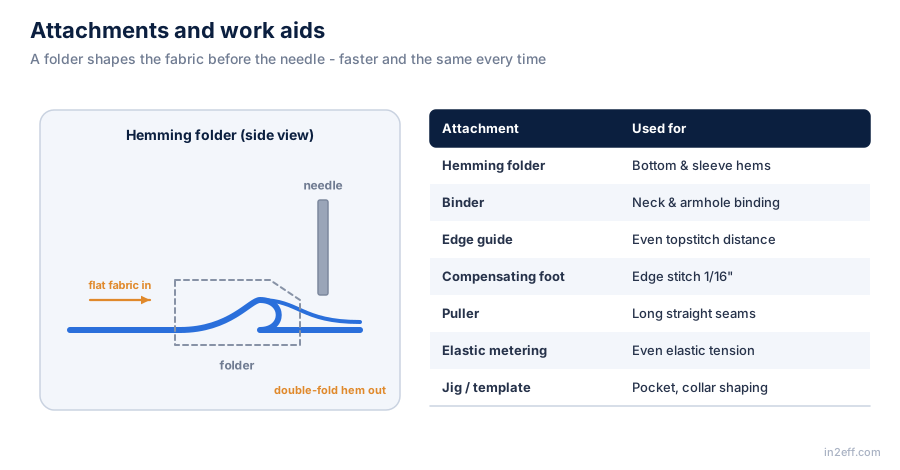
Common attachments
- Hemming folder - turns a single or double-fold hem as the fabric enters the needle. Used for bottom and sleeve hems.
- Binder - folds a binding strip round the edge (necklines, armholes, bag edges).
- Edge guide - a fixed or magnetic stop that keeps the seam allowance or topstitch distance even.
- Compensating foot - one side of the foot is higher, for edge stitching at 1/16" or 1/4".
- Puller - a roller behind the needle that pulls the fabric; keeps long seams straight and reduces puckering.
- Elastic metering device - feeds elastic at a fixed tension so every waistband has the same stretch.
- Jigs and templates - plates that hold parts in shape (pocket flaps, collars, labels) so the operator sews along a track.
How much can they save?
Typical examples from sewing floors (your results depend on style and operator):
| Operation | Without aid | With aid | Main gain |
|---|---|---|---|
| Sleeve hem (knit) | Hand fold + sew | Folder | 15-25% less time, even hem width |
| Edge stitch collar | Free hand | Compensating foot | Fewer uneven stitches |
| Pocket shaping | Iron + sew | Template | Same shape every piece |
| Waistband elastic | Hand stretch | Metering device | Even stretch, no rework |
Choosing and using an attachment
- Start with the bottleneck or the operation with the highest DHU.
- Watch the operator: how much time is spent positioning and folding rather than sewing? That is what an attachment removes.
- Choose the right size for fabric thickness and seam width - a wrong folder causes twisting.
- Train the operator and let the learning curve settle (2-5 days).
- Re-study the SAM and update the operation bulletin and the line balance.
Tip: Keep an attachment register: attachment, size, which machine, which style. When a style repeats, the line is ready on day one.
Key points
- Attachments remove handling time and variation.
- Target bottlenecks and high-defect operations first.
- Measure before and after - then update SAM and the line plan.