The needle is the cheapest part of a sewing machine and the one that causes the most quality problems: skipped stitches, fabric holes, broken threads and - worst of all - broken needle pieces inside a garment.
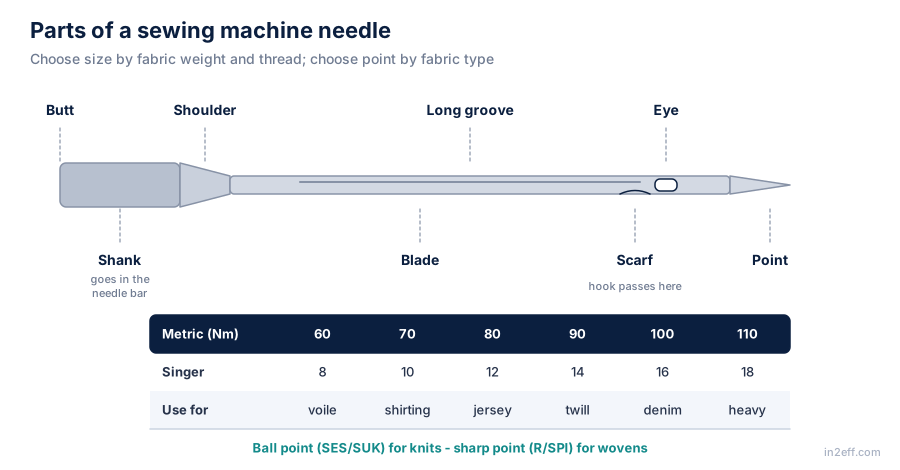
Parts of the needle
- Butt and shank - the top part that is clamped in the needle bar. Industrial needles often have a round shank; the needle system (for example DB×1, DP×5, UY128GAS) must match the machine.
- Blade - the long body. Its thickness is the needle size.
- Long groove - protects the thread on its way down.
- Scarf - a recess above the eye that lets the hook point get close.
- Eye - the hole for the thread. Should be about 40% bigger than the thread.
- Point - first contact with the fabric. Its shape decides whether it pushes yarns aside or cuts them.
Sizes
| Metric (Nm) | Singer | Typical use |
|---|---|---|
| 60-65 | 8-9 | Voile, lingerie, fine knits |
| 70-75 | 10-11 | Shirting, single jersey |
| 80 | 12 | Jersey, poplin, light twill |
| 90 | 14 | Twill, fleece, chino |
| 100-110 | 16-18 | Denim, canvas, workwear |
Metric size = blade diameter in hundredths of a millimetre (Nm 90 = 0.9 mm).
Points
- Light ball point (SES) - single jersey, interlock, most knits. Slips between loops instead of cutting.
- Medium ball point (SUK) - heavier knits, rib, elastic, lycra blends.
- Sharp / normal point (R, SPI) - wovens; SPI = slim set point for fine, dense wovens and topstitching.
- Cutting points (wedge, diamond) - leather and coated fabrics only.
Tip: A needle hole or cut yarn in knit fabric almost always means wrong point, too big a size or a blunt needle - not the operator.
Needle-change routine and broken-needle policy
- Issue new needles only against the old one (or all broken pieces).
- Record every change in the needle register: date, line, machine, operator, reason.
- If a needle breaks, find all pieces, tape them on the register, and get supervisor sign-off before work restarts.
- If a piece is missing, the garments from that bundle go to metal detection or are quarantined.
- Change needles on a schedule (for example every shift or every day on knits) even if they look fine.
Key points
- Size by fabric weight and thread; point by fabric type.
- Ball point for knits, sharp point for wovens.
- A strict needle policy is a buyer requirement and protects the end customer.