Good mechanics fix problems in a fixed order: threading → needle → tension → feed → timing. Most faults are found in the first three steps, without opening the machine.
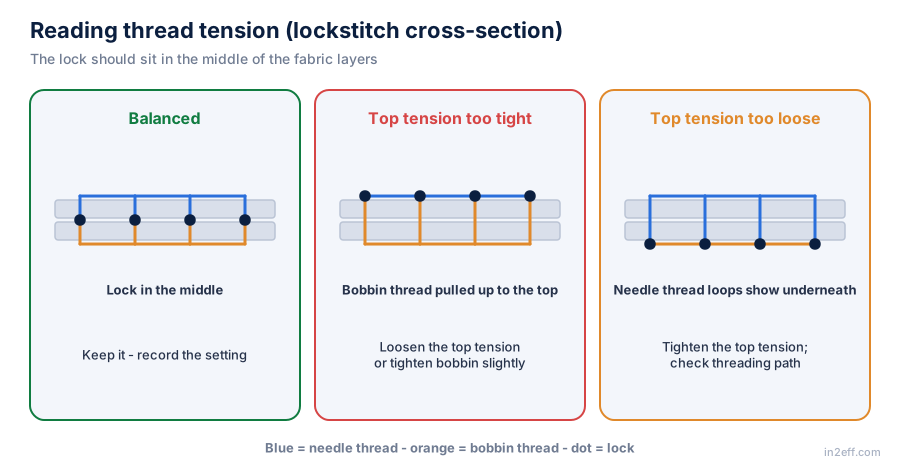
Reading tension from the seam
On a 301 lockstitch the lock should sit in the middle of the fabric layers.
- Bobbin thread visible on top → top tension too tight (or bobbin too loose).
- Needle thread loops underneath → top tension too loose, or the thread missed the take-up lever / tension discs.
- Seam puckers but tension looks balanced → both tensions too tight, wrong thread, or feed problem.
Tip: Set the bobbin tension first (the bobbin case should drop slowly when you hold its thread and jerk lightly), then adjust the top tension to balance it.
Fault - cause - fix
| Fault | Likely causes | Fixes |
|---|---|---|
| Skipped stitches | Needle bent, turned or wrong size/point; hook timing; thread too thick for needle | Change and fit needle correctly; reset timing & gap; match thread/needle |
| Thread breaking | Burrs on hook, needle plate or guides; tension too tight; poor thread; needle too small | Polish or replace parts; reduce tension; better thread; bigger needle |
| Needle breaking | Operator pulling fabric; needle hitting plate/hook; thick seams | Train feeding; check alignment; use stronger needle, hump jumper |
| Seam puckering | Tension too tight; thread too thick; uneven feed; SPI too high | Reduce tension; finer thread; adjust feed/foot pressure, puller; lower SPI |
| Uneven stitch length | Weak foot pressure; worn feed dog; operator holding fabric | Increase pressure; replace feed dog; training |
| Overlock edge loops | Looper tension loose; knife dull; wrong stitch width | Adjust looper tension; change knife; set width |
| Oil stains | Over-oiling; leaking seals; dirty thread path | Correct oil level; change seals; daily cleaning |
A simple troubleshooting habit
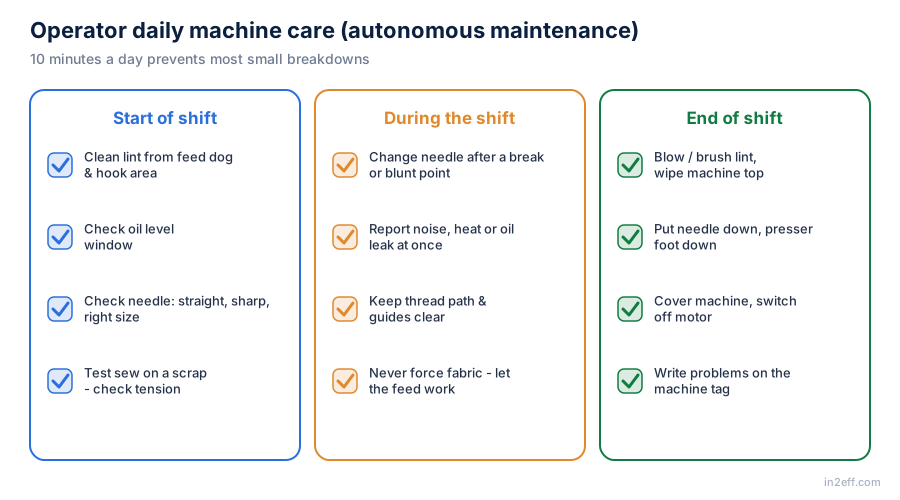
- Re-thread completely with the presser foot up (so the discs are open).
- Change the needle - new, correct size and point, correctly turned.
- Clean the bobbin case and hook area; check the bobbin is wound evenly.
- Balance tension on a scrap of the same fabric.
- Only then check feed, timing and gap.
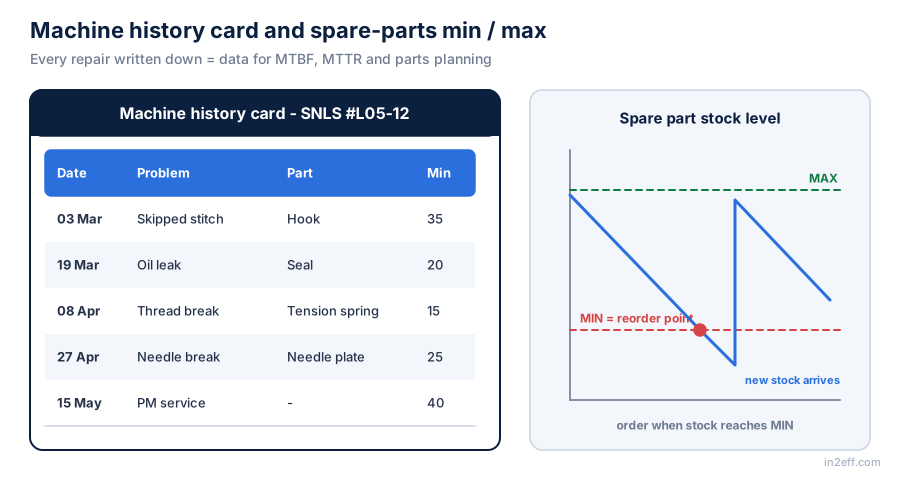
Write what you found on the machine history card. Repeated faults on one machine point to a worn part.
Key points
- Read the seam to read the tension.
- Fix in order: threading, needle, tension, feed, timing.
- Record the cause - repeated faults need a part change, not another adjustment.