"The mechanics are busy" is not a measure. With four simple KPIs you can see whether maintenance is getting better and where to act.
The four KPIs
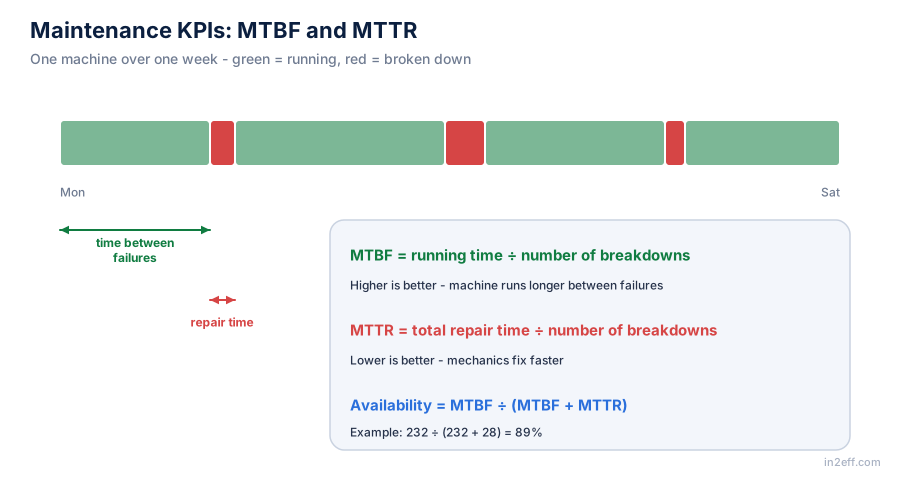
Formula: MTBF = total running time ÷ number of breakdowns
Mean time between failures - how long a machine (or line) runs before it breaks down. Higher is better.
Formula: MTTR = total repair time ÷ number of breakdowns
Mean time to repair - from the moment the machine stops to the moment it sews good pieces again. Include waiting for the mechanic and parts. Lower is better.
Formula: Availability = MTBF ÷ (MTBF + MTTR) × 100
Formula: Downtime % = breakdown minutes ÷ planned running minutes × 100
Worked example - one line, one week
A line has 40 machines and runs 6 days × 10 hours = 60 hours = 3,600 minutes per machine.
- Planned machine minutes = 40 × 3,600 = 144,000 min
- Breakdowns in the week = 24, total repair time = 720 min (includes waiting)
- Running time = 144,000 − 720 = 143,280 min
- MTBF = 143,280 ÷ 24 = 5,970 min ≈ 99.5 hours
- MTTR = 720 ÷ 24 = 30 min
- Availability = 5,970 ÷ (5,970 + 30) = 99.5%
- Downtime = 720 ÷ 144,000 = 0.5%
0.5% sounds small, but if the breakdowns hit bottleneck operations the line can lose far more output than 0.5%. Report bottleneck downtime separately.
Splitting MTTR
| Part of MTTR | Typical cause | Action |
|---|---|---|
| Waiting for mechanic | Too few mechanics, no call system | Andon light, mechanic per 2 lines |
| Diagnosis | Low skill | Troubleshooting training |
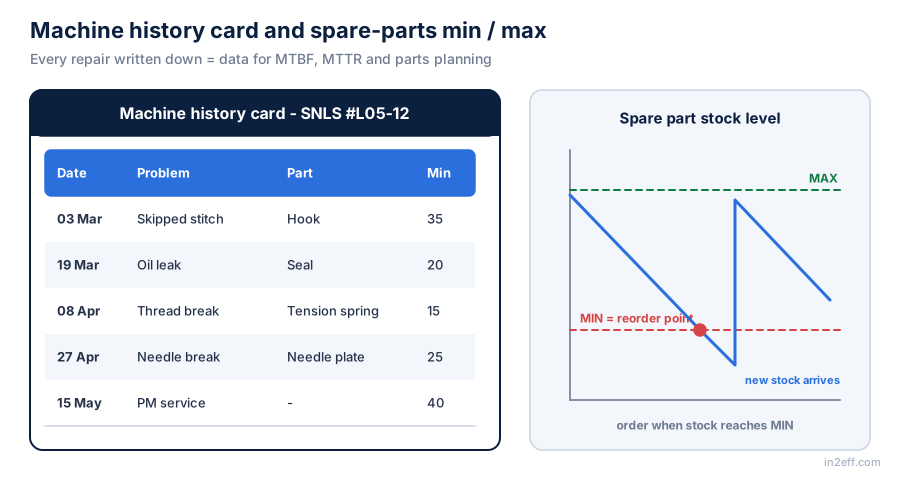
| Waiting for parts | Spare parts out of stock | Min/max for fast-moving parts |
| Repair | Complex job | Spare machine swap, repair offline |
Weekly maintenance report
| Line | Breakdowns | MTTR (min) | MTBF (h) | Top 3 faults | Action |
|---|---|---|---|---|---|
| L01 | 18 | 22 | 133 | Thread break, skip, oil | Hook polish on 4 m/c |
| L02 | 31 | 41 | 77 | Skip, needle break | Timing check all DNLS |
Key points
- MTBF up and MTTR down = better maintenance.
- Count waiting time inside MTTR - that is what the line feels.
- Look at bottleneck downtime and the top repeated faults, not just the average.