Water treatment and fire safety are the two utilities that buyers, auditors and government inspectors always check. Both protect people - workers, neighbours and the environment.
Water and ETP
Water in: most factories use deep tube-wells. A water treatment plant (WTP) softens and filters water for the boiler and washing.
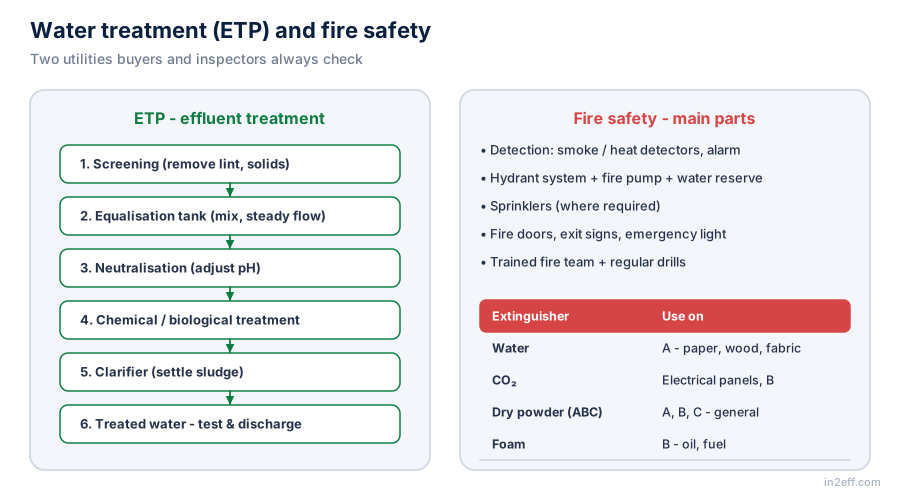
Water out: washing, dyeing and printing produce coloured, chemical waste water. The effluent treatment plant (ETP) cleans it before discharge:
- Screening - removes lint, threads and solids.
- Equalisation tank - mixes the flow so the load is steady through the day.
- Neutralisation - adjusts pH to the target range.
- Chemical and/or biological treatment - coagulation and flocculation, and/or bacteria that break down organic load.
- Clarifier - sludge settles; clear water goes on.
- Testing and discharge - pH, BOD, COD, TSS and other values must meet the Department of Environment limits; sludge is dewatered and disposed of properly.
Note: An ETP must run whenever the wet process runs - including nights and holidays. Keep the flow meter, electricity meter and chemical-use logs; auditors compare them.
Fire safety - the main parts
- Detection and alarm - smoke and heat detectors, manual call points, alarm audible on every floor.
- Fire pump, water reserve and hydrant system - landing valves and hose reels on each floor.
- Sprinklers where the building standard requires them.
- Passive protection - fire doors, enclosed stairs, fire-rated walls around stores and generator rooms.
- Exit routes - clear aisles, lit exit signs, emergency lights, doors that open outward and are never locked during work.
- People - trained fire team on every floor and regular evacuation drills.
Which extinguisher on which fire
| Type | Use on | Do not use on |
|---|---|---|
| Water | Class A: fabric, paper, wood | Electrical, oil |
| CO₂ | Electrical panels, small Class B | Large open fires (gas disperses) |
| Dry powder (ABC) | A, B and C - general use | Leaves residue on machines |
| Foam | Class B: oil, fuel | Live electrical |
Remember the PASS method: Pull the pin, Aim at the base, Squeeze, Sweep.
What inspectors look for
- Exits and aisles clear of cartons and bundles
- Extinguishers charged, tagged and at the marked place
- Fire pump on auto, alarm tested, drill records
- ETP running with logs that match meter readings
Key points
- ETP cleans process water in steps and must run whenever wet processing runs.
- Fire safety = detection, water, exits and trained people.
- Keep logs and records - they prove the systems are working.