Production managers watch output; the utility team keeps the things running that production takes for granted. When the generator trips, the boiler pressure drops or the compressor stops, every department feels it within minutes.
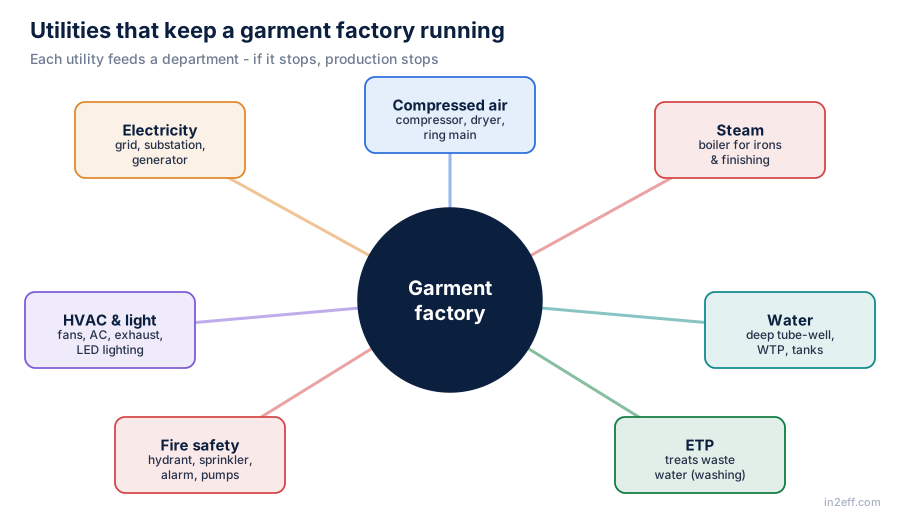
The main utilities and who uses them
| Utility | Main equipment | Used by |
|---|---|---|
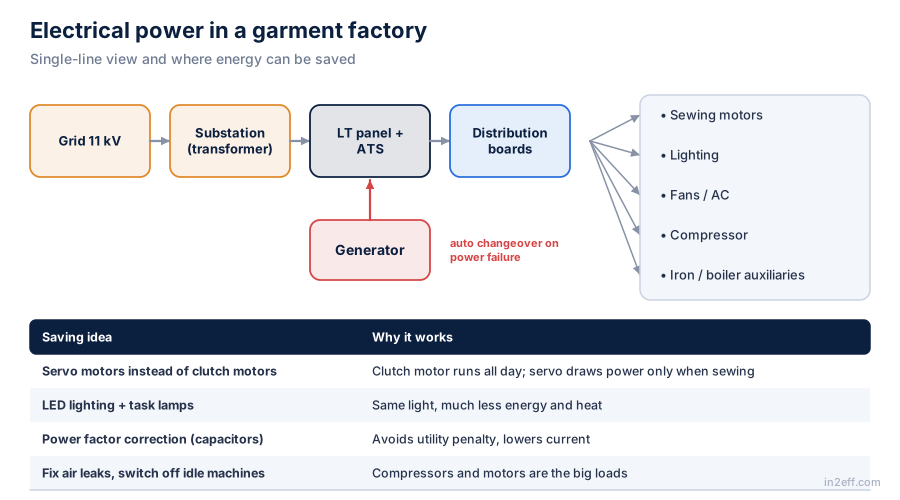
| Electricity | Grid connection, substation, generators, distribution boards | Every machine, lights, fans, AC |
| Compressed air | Compressors, receiver, dryer, ring main | Thread trimmers, fusing, spot guns, auto machines, cutting tables |
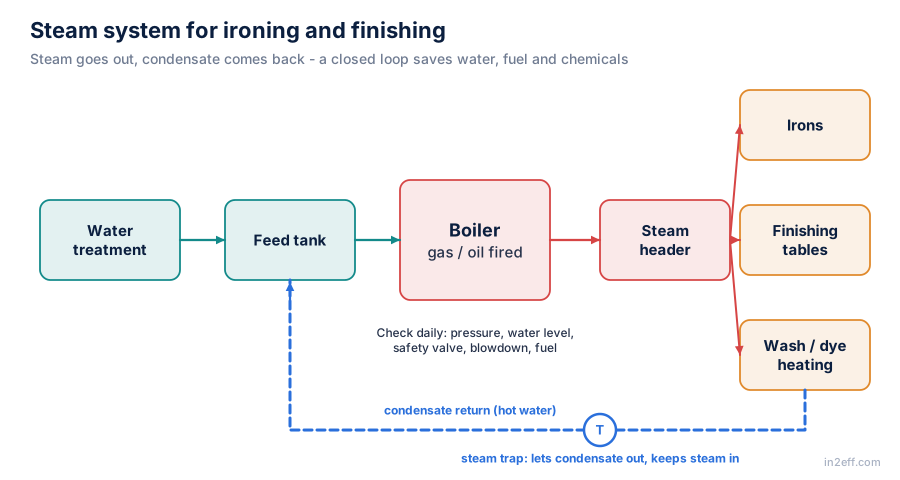
| Steam | Boiler, steam lines, traps, condensate return | Irons, finishing tables, washing & dyeing heat |
| Water | Deep tube-well, water treatment plant (WTP), tanks | Boiler feed, washing, canteen, toilets |
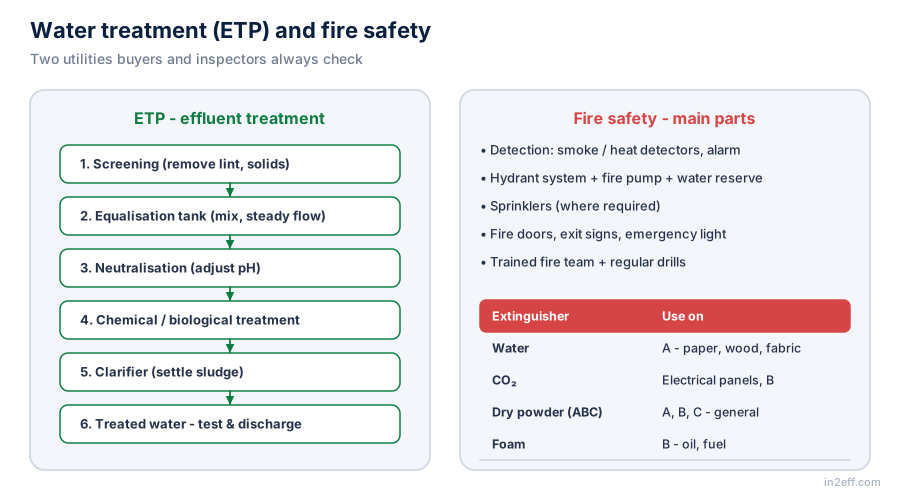
| ETP | Effluent treatment plant | Washing, dyeing, printing waste water |
| HVAC & lighting | Exhaust fans, AC, evaporative cooling, LED lights | Workers' comfort, quality inspection |
| Fire safety | Fire pump, hydrant, sprinklers, alarm, detectors | Whole building |
What the utility team checks every day
- Generator & substation - fuel level, oil, battery, load per phase, running hours.
- Compressor - pressure, temperature, drain water from receiver, dryer working, leaks.
- Boiler - steam pressure, water level glass, safety valve, blowdown, fuel use.
- Water - tank levels, WTP hardness / TDS reading for boiler feed.
- ETP - flow, pH, chemical dosing, sludge, discharge test values.
- Fire system - pump on auto, hydrant pressure, alarm panel normal.
Readings go into a utility log sheet every 2 hours. Trends catch problems before breakdowns.
Utility cost in your costing
Utility bills (electricity, gas, diesel, water, chemicals) are part of the factory overhead used to calculate the cost per minute. A factory that cuts utility cost by 10% lowers its CM cost without touching wages.
Tip: Divide monthly utility cost by produced minutes (output × SAM). Tracking "utility cost per produced minute" shows real savings even when production volume changes.
Key points
- Production depends on power, air, steam and water every minute.
- Daily readings and logs catch problems early.
- Measure utility cost per produced minute, not just the monthly bill.