Finishing runs on steam. If steam pressure drops, irons go wet, garments get water marks and the finishing section slows down - right before shipment.
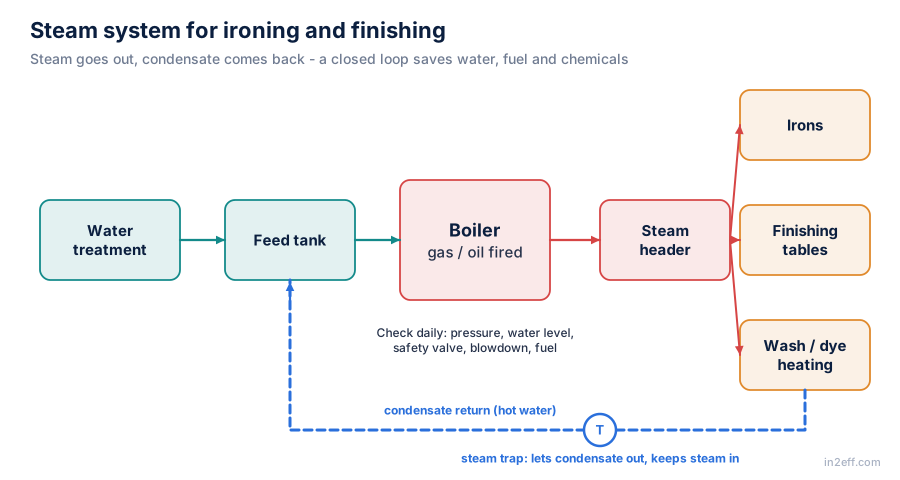
How the system works
- Water treatment - raw water is softened (hardness removed) so scale does not build inside the boiler.
- Feed tank - holds treated water and returned condensate, ideally hot.
- Boiler - gas, oil or biomass fired; produces steam at a set pressure (often 6-10 bar).
- Steam header and lines - carry steam to the irons, finishing tables, and wash/dye heating. Lines must be insulated.
- Steam traps - let condensate (water) out of the lines while keeping steam in.
- Condensate return - hot water goes back to the feed tank. This saves water, treatment chemicals and fuel.
Daily boiler checks (by a certified operator)
| Check | Why |
|---|---|
| Steam pressure and water level gauge glass | Low water is the most dangerous boiler fault |
| Safety valve (test as per schedule) | Must open before pressure is too high |
| Blowdown (as per water test) | Removes sludge and dissolved solids |
| Burner flame, fuel use, flue gas temperature | Efficiency and safe combustion |
| Feed water hardness / TDS | Prevents scale and tube failure |
| Log sheet signed every shift | Legal requirement and early warning |
Note: Boilers are pressure vessels. In Bangladesh they need registration and periodic inspection by the boiler authority, and only trained, certified operators should run them.
Where steam is wasted
- Failed steam traps - stuck open, they blow live steam straight to drain.
- Bare pipes and valves - uninsulated lines lose heat and make wet steam.
- Leaks at iron hoses and valves on the finishing tables.
- No condensate return - hot water thrown away means more fuel and more chemicals.
- Irons left on during breaks and after the shift.
A simple monthly trap survey and insulating bare pipes are often the fastest paybacks in the boiler house.
Key points
- Treated water, working traps and condensate return keep steam dry and cheap.
- Low water level and pressure are safety issues - follow the log and checks.
- Fix traps, insulate, and switch off irons when not in use.