Rework fixes one garment. Root cause analysis fixes the process, so the same defect does not come back tomorrow. Two simple tools - the fishbone diagram and 5 Why - are enough for most problems on a garment floor.
Step 1 - state the problem with data
Not "quality is bad on Line 5" but: "Line 5 DHU is 9% for style 2045 since Monday vs 4% target; 60% of defects are open seam at collar attach."
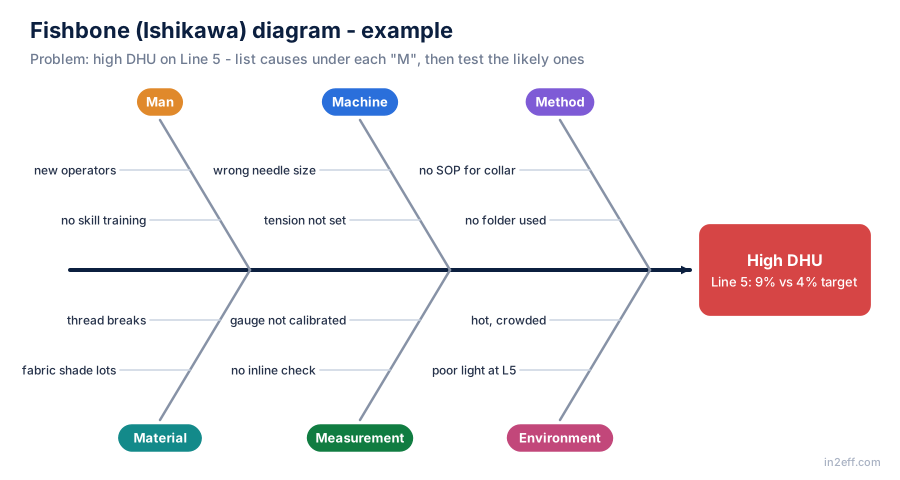
Step 2 - fishbone (Ishikawa): list possible causes
Draw the problem at the head; list possible causes on the bones under the 6 Ms:
- Man - new operator, not trained on this collar, fatigue
- Machine - wrong needle, tension, worn feed dog, no edge guide
- Method - no SOP for collar attach, no folder, wrong sequence
- Material - collar size varies from cutting, fabric frays, thread breaks
- Measurement - no inline check at this operation, wrong gauge
- Environment - poor light, hot area, crowded workstation
Do it at the line, with the operator, supervisor, mechanic and QC.
Step 3 - test, then ask 5 Why
Check the likely causes with facts (watch the operation, measure collars, check the machine). Then take the confirmed cause and ask "why?" until you reach something you can fix in the system:
- Why is the seam open? → The collar edge misses the needle.
- Why does it miss? → Collar widths vary by up to 4 mm.
- Why do they vary? → The collar parts are cut from the top and bottom of a high lay.
- Why is the lay so high? → Cutting increased plies to catch up with input.
- Why? → No maximum lay height standard for this fabric.
Root cause: no lay-height standard for this fabric → action: set and train a maximum lay height, plus an edge guide at collar attach.
Step 4 - CAPA: corrective and preventive action
| Item | Example |
|---|---|
| Problem | Open seam at collar attach, L5, DHU 9% |
| Root cause | Collar width variation from high lays; no edge guide |
| Correction (now) | 100% check of WIP collars; rework open seams |
| Corrective action (this cause) | Max lay height set; edge guide fitted at collar attach |
| Preventive action (other lines/styles) | Lay-height standard added to cutting SOP for all fabrics |
| Owner / due date | Cutting manager, IE - by Thursday |
| Verification | L5 DHU ≤ 4% for 3 days; collar width within ±1 mm |
Tip: Close every CAPA only after verification with data. A CAPA closed on the day it is written usually comes back.
Key points
- Define the problem with numbers.
- Fishbone to list causes; facts to confirm; 5 Why to reach the system cause.
- CAPA = correction now, corrective action for this cause, preventive action elsewhere - verified with data.