Quality cannot be inspected into a garment at the end - by then the fabric is cut, the seams are sewn and the cost is spent. A good quality system has checkpoints at every stage, each catching the defects that stage creates.
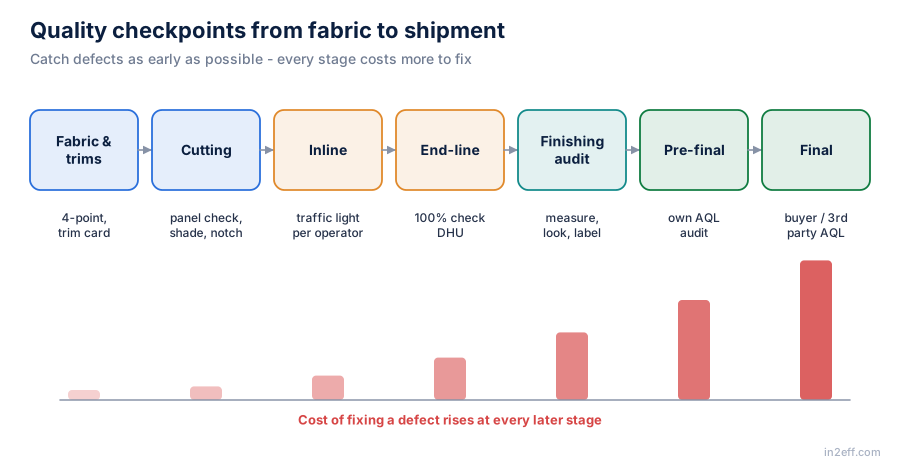
The seven checkpoints
| Checkpoint | What is checked | Who |
|---|---|---|
| 1. Fabric & trims | 4-point inspection, shade, GSM, width; trims vs trim card | Store QC / fabric QC |
| 2. Cutting | Panel measurements vs pattern, notches, shade within bundle, numbering | Cutting QC |
| 3. Inline | Each operator's work, early in the bundle - traffic light system | Roving / inline QC |
| 4. End-line | 100% check of finished garments from the line - DHU | End-line QC |
| 5. Finishing audit | Measurements, appearance, pressing, labels, trims after finishing | Finishing QC |
| 6. Pre-final | Factory's own AQL audit on packed cartons | QA department |
| 7. Final | Buyer or third-party AQL inspection | Buyer QA / 3rd party |
QC and QA - the difference
- QC (quality control) - checks the product: inspects, finds and separates defects.
- QA (quality assurance) - checks the system: standards, training, audits, root-cause and prevention.
A factory needs both: QC protects this shipment; QA protects the next ones.
Why earlier is cheaper
A shade problem found at fabric inspection costs one roll. Found at cutting, it costs re-cutting. Found at end-line, it costs the cut panels, sewing minutes and maybe delivery. Found at final inspection, it can cost the shipment. Move inspection effort upstream.
Tip: Track defects by checkpoint where found and process where created. If many sewing defects are only found at end-line, inline checking needs strengthening.
The quality documents
- Approved sample, measurement chart, trim card and buyer quality manual at the line.
- Inline and end-line defect reports by hour, with DHU per operator and line.
- Defect codes (the same list everywhere) so data can be added up.
- Audit reports and corrective action records.
Key points
- Seven checkpoints, each catching its own defects.
- QC finds defects; QA prevents them.
- The earlier you catch a defect, the cheaper it is.