Most garment materials are bought for a specific order, but many items run all the time: sewing thread for common colours, needles, poly bags, cartons, stationery, chemicals, spare parts. These need inventory control - enough to never stop production, not so much that cash sits on the shelf.
ABC analysis - focus where the money is
- List items with annual usage quantity × unit price = annual value.
- Sort from highest to lowest value and add a running % of total value.
- Classify (typical split):
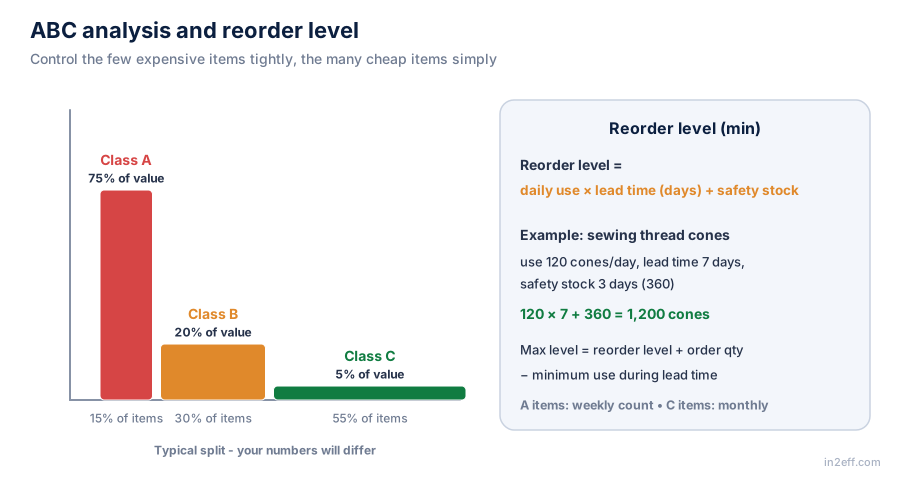
- A - about 10-20% of items, about 70-80% of value → tight control, weekly count, careful ordering.
- B - about 30% of items, about 15-25% of value → normal control, monthly count.
- C - about 50% of items, about 5% of value → simple control, bulk buy, quarterly count.
Reorder level, safety stock and maximum
Formula: Reorder level = average daily use × lead time (days) + safety stock
Formula: Safety stock ≈ daily use × days of protection (for late deliveries or usage peaks)
Formula: Maximum level = reorder level + reorder quantity − (minimum daily use × minimum lead time)
Example - white sewing thread cones:
- Average use 120 cones/day, lead time 7 days, safety stock 3 days = 360
- Reorder level = 120 × 7 + 360 = 1,200 cones
- Order quantity 1,500 → maximum ≈ 1,200 + 1,500 − (90 × 5) = 2,250 cones
When the bin card balance reaches 1,200, raise the purchase requisition.
Cycle counting instead of one big count
Rather than closing the store once a year:
- Count A items weekly, B monthly, C quarterly - a few locations every day.
- Compare with the bin card / system; investigate every difference above a small tolerance.
- Common causes: issue without requisition, wrong location, unit mix-ups (cone vs box), receipts not entered.
Formula: Stock accuracy % = locations with no difference ÷ locations counted × 100
Dead and slow stock
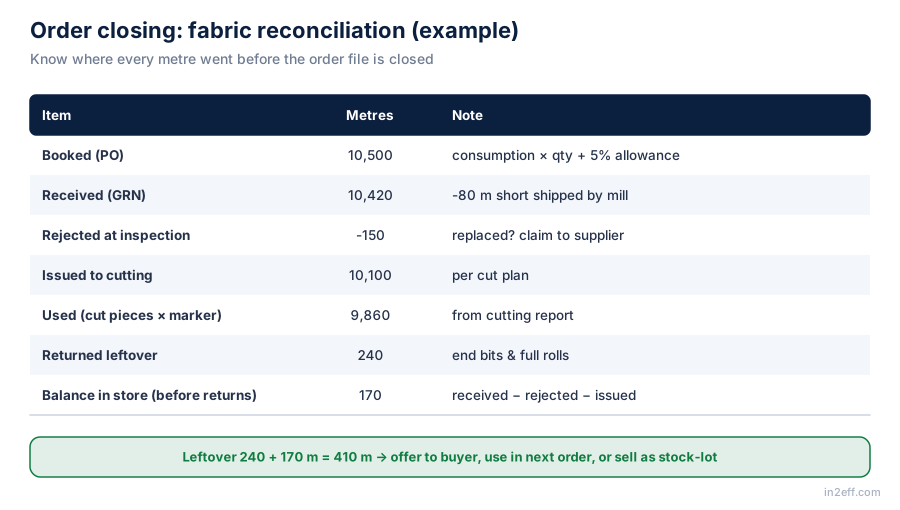
Review every quarter: items with no movement for 6-12 months. Options - use in another order (with buyer approval), return to supplier, sell as stock-lot, or write off. Dead stock still costs space and handling.
Key points
- ABC: control the few high-value items tightly.
- Reorder level = use during lead time + safety stock.
- Cycle counts keep stock accurate all year.