Electricity is usually the largest utility cost in a sewing factory, and almost every machine depends on it. Understanding the basic layout helps production and IE people talk with the electrical team - and find savings.
From the grid to the machine
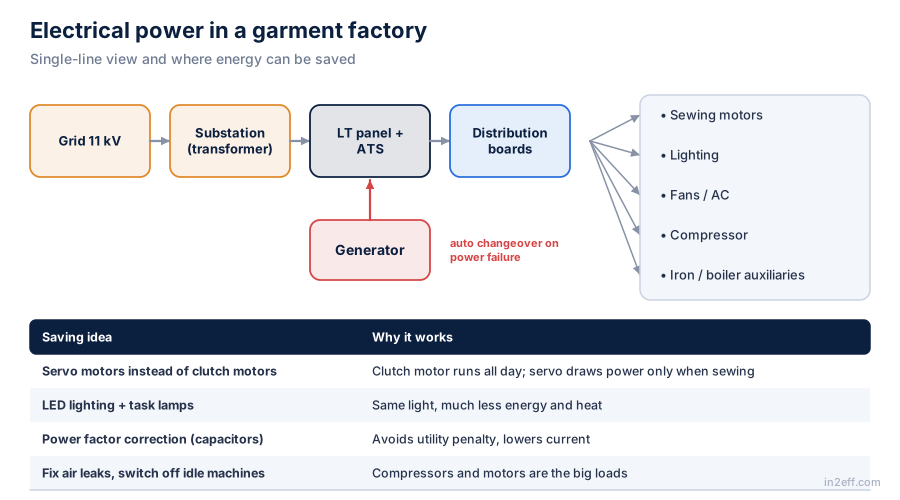
- Grid supply (often 11 kV) enters the factory substation.
- Transformer steps it down to 400/230 V.
- LT (low tension) panel with the main breaker and the ATS (automatic transfer switch) that changes over to the generator during power failure.
- Distribution boards (DBs) on each floor feed sewing lines, lighting, fans/AC and other loads.
- Each line has its own breaker so one fault does not stop the whole floor.
Three terms worth knowing
- kW and kWh - power (how much at a moment) and energy (power × hours) - the bill is mainly in kWh.
- Power factor (PF) - how well current is used. Motors and old lights lower PF. Low PF means higher current, hotter cables and a penalty from the utility. Capacitor banks correct it (target about 0.95 or higher).
- Load balancing - the three phases should carry similar load. Unbalanced phases overheat the transformer and trip breakers.
Savings that pay back fastest
| Idea | Why it saves |
|---|---|
| Servo motors instead of clutch motors on sewing machines | A clutch motor spins all shift; a servo draws power only when the operator presses the pedal. Savings are often 50% or more of the machine motor energy. |
| LED lighting with task lamps at machines | Same or better light for much less power and heat (less AC load). |
| Switch off at breaks and after shift | Lights, fans, irons, compressors - assign one person per floor. |
| Power factor correction | Removes penalty and reduces losses. |
| Efficient fans and controlled AC set-points | Cooling is a big load in hot months. |
| Sub-meters per floor / department | What is measured gets managed. |
Tip: Calculate payback before buying: saving per year ÷ cost. Servo motor and LED projects often pay back in about one to two years, depending on hours and tariff.
Safety first
Only authorised electricians open panels. Keep panel rooms locked, dry and clear; use rubber mats; keep the single-line diagram on the panel door; test earthing and do thermal scanning of panels yearly - loose connections are a common cause of factory fires.
Key points
- Grid → transformer → LT panel/ATS → DBs → machines; generator backs it up.
- Watch power factor and phase balance.
- Servo motors, LEDs and switch-off discipline are the quickest savings.