Checkers can find defects; only the line can stop making them. For each common defect, know the cause at the machine and the prevention - then use defect data to pick which one to attack first.
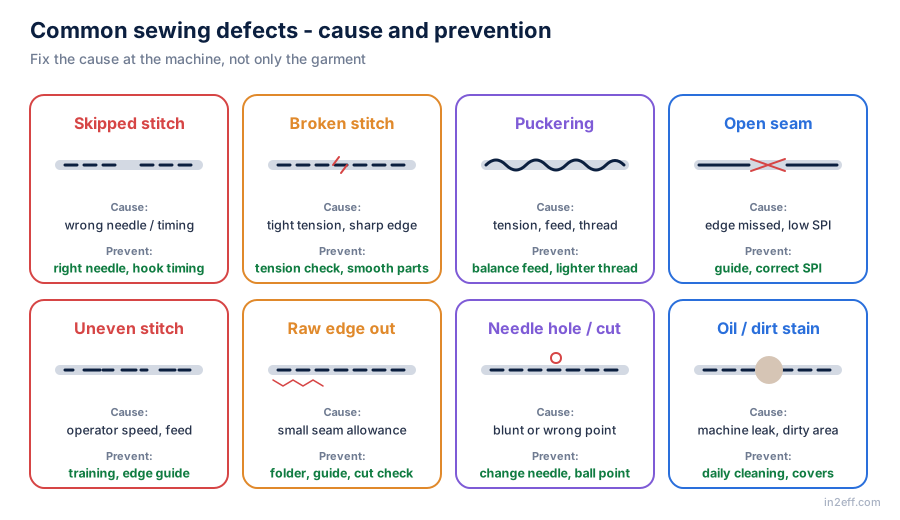
The common defects
| Defect | Common causes | Prevention |
|---|---|---|
| Skipped stitch | Wrong needle size/point, needle fitted wrong, hook timing, thread too thick | Correct needle, timing check, matched thread |
| Broken stitch / seam crack | Tension too tight, sharp parts cutting thread, low-stretch stitch on knit | Balance tension, polish parts, use 400/500/600 stitch on knit |
| Puckering | Tight tension, heavy thread on light fabric, uneven feed, too high SPI | Lighter thread, balanced tension, puller/walking foot, correct SPI |
| Open seam | Seam allowance too small, operator missed edge, low SPI | Edge guide, folder, cutting accuracy check |
| Uneven stitch / wavy line | Operator speed and handling, weak foot pressure, worn feed dog | Training, guides, maintenance |
| Raw edge visible | Small seam allowance, wrong folder size, fraying fabric | Correct folder, guide, overlock first |
| Needle hole / fabric cut | Blunt needle, wrong point (sharp on knit), needle too big | Ball point on knit, needle change schedule |
| Oil / dirt stain | Over-oiling, leaking machine, dirty tables, poor handling | Daily cleaning, covers, correct oil level, clean bins |
| Wrong label / missing trims | Mixed trims at the line, no checklist | Trim card at the line, one style per line area |
| Shading within garment | Panels from different plies or rolls mixed | Numbering, bundle control, shade band |
Use the data - Pareto first
- Code every defect the same way at inline and end-line.
- Each day, rank defects by count (Pareto). Usually 3-4 defect types make 70-80% of the DHU.
- For the top defect, go to the operations that create it, find the cause (machine, method, material, operator) and fix it.
- Check the DHU next day - did it fall?
Tip: A defect display board with real samples of "good" and "not good" at each critical operation trains operators faster than any instruction sheet.
Key points
- Every defect has a cause at the machine or method.
- Fix the cause, not only the garment (rework hides the problem).
- Use Pareto to attack the few defects that make most of the DHU.